AC-807BP (MOI-BP) is a series of special blocked isocyanate acrylate monomers developed by Top Chemical.
The monomer has both a C=C double bond and a closed NCO group within its molecule. Through high-temperature unsealing, the amine esterification reaction of NCO groups can easily and conveniently introduce unsaturated double bond functional groups into oligomers or polymers containing hydroxyl groups for UV/EB curing. On the contrary, free radical polymerization of double bonds can also be used to prepare polymers with side chains containing multiple blocked NCO groups for thermal or moisture curing.
■ Performance and characteristics
● Higher molecular design freedom
●Synthesis of oligomers/polymers with multiple closed NCO groups on the side chain
●Reduce reaction steps and improve production efficiency
● Reduce the usage of dilution monomers or solvents
● High reactivity
●Narrow molecular weight distribution
● Lower product viscosity
● Reduce costs
■ Physical property data
|
project |
parameter |
|
chemical name |
[(3,5-dimethyl-1H-pyrazolyl) carbonyl] ethyl methacrylate |
|
CAS |
217437-44-0 |
viscosity
mPa.s |
120-180 |
|
appearance |
Light yellow transparent liquid |
■ Reaction mechanism of closed isocyanate monomers
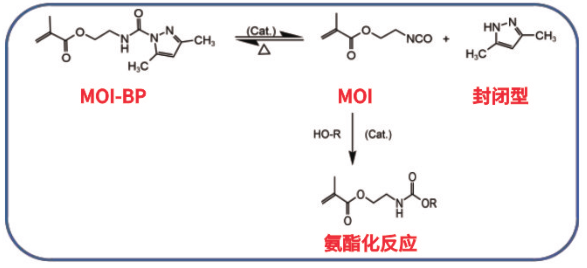
The blocking and unblocking of isocyanates is an equilibrium reaction.
Under heating, the sealing agent decreases as it evaporates, and the equilibrium shifts towards the direction of unsealing.
Catalysts can accelerate the unsealing reaction.
Stable storage without the presence of active hydrogen.
■ The influence of catalyst on the unsealing temperature
Reaction of blocked isocyanate monomers with n-octanol at different temperatures in solvent-free systems
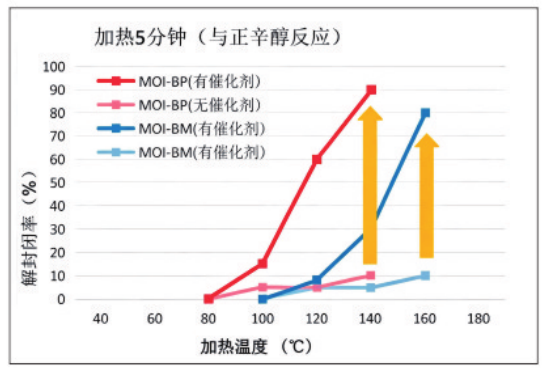
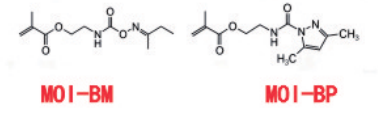
Composition: n-Octanol: Closed isocyanate monomer=4:1 (molar ratio)
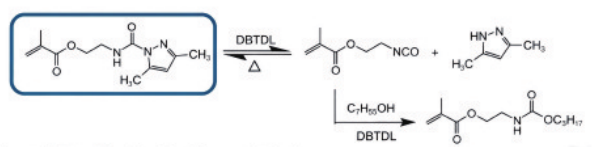
Catalyst: dibutyltin dilaurate (DBTDL)
1wt% addition
Solvent: Not used
Analysis method: HPLC quantitative determination of residual amount of blocked isocyanates
Mechanism of unsealing reaction
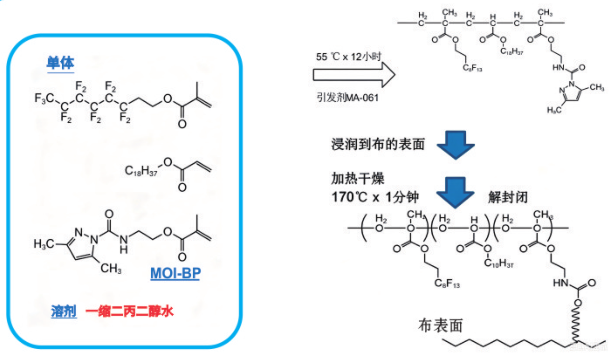
■ Examples of the use of closed isocyanate monomers
Composition of emulsion
|


